
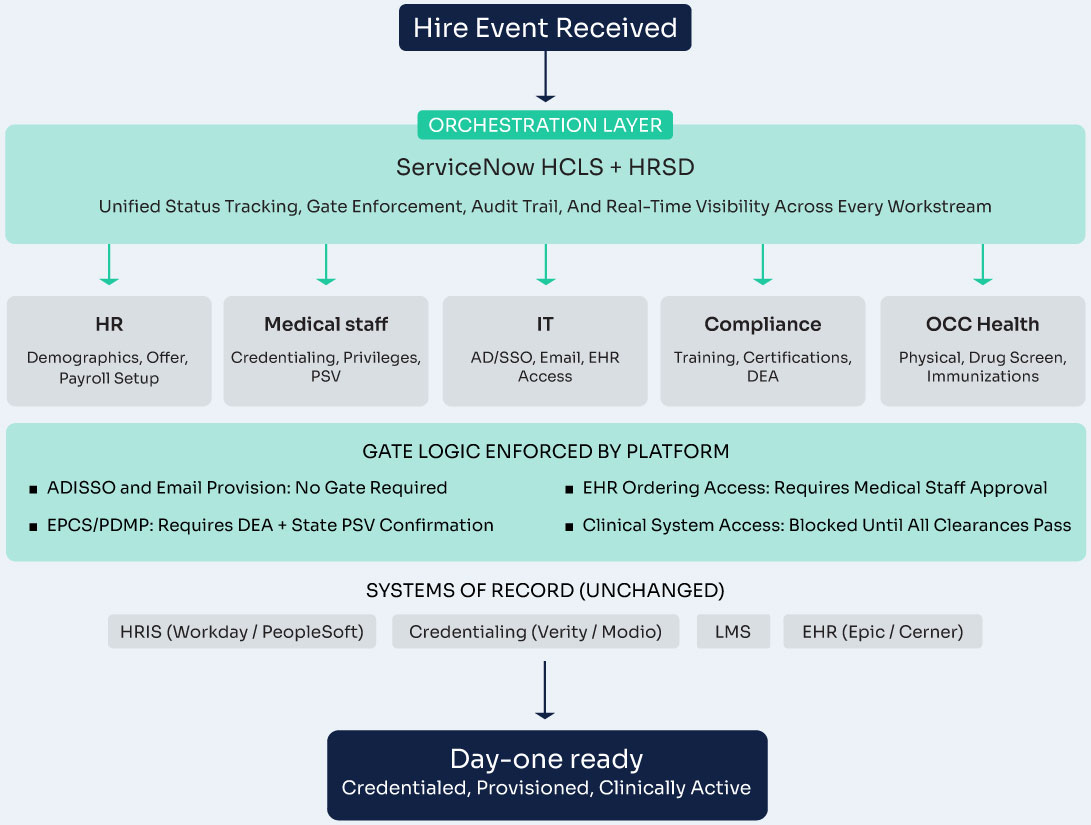
Getting a provider from offer acceptance to credentialed, provisioned, and clinically active touches HR, medical staff, IT, compliance training, and occupational health simultaneously. ServiceNow HCLS and HRSD do not replace any of those systems. They orchestrate across all of them, so nothing waits on an email and nothing falls through a gap.
Provider Onboarding Fails in the Handoffs, Not the Individual Steps
Every team involved in bringing a provider to active clinical status does their job reasonably well in isolation. HR processes the hire. The medical staff office runs credentialing. IT opens a ticket for system access. The compliance team assigns training. Occupational health schedules the physical. The problem is not execution within any single team. No single system knows where all of it stands, and every delay in one workstream silently blocks the ones that depend on it.
A new physician cannot get EHR ordering access until credentialing clears. Credentialing cannot close until documents are complete. Documents cannot be complete if HR has not transferred the demographic data the credentialing team needs. Meanwhile, the provider is sitting in orientation wondering why their Epic login does not work, and the department chief is wondering why their new hire cannot see patients yet.
This is not a people problem. It is an orchestration problem. The tools exist. The expertise exists. A single platform that knows the status of every step, triggers the right action when a gate clears, and surfaces the full picture to the people who need to act is what is missing.
The Hidden Cost of Fragmentation
What delayed time-to-active actually costs is significant across four dimensions:
- Revenue cycle: A physician who cannot bill for 30 extra days because credentialing is waiting on a document costs the organization $2,000 to $5,000 or more per day for a procedural specialist (orthopedics, cardiology, gastroenterology). Primary care and behavioral health providers carry lower but still material per-day opportunity cost in the range of $800 to $1,500.
- Compliance exposure: A provider who begins clinical activities before credentialing is complete creates direct liability. Manual handoffs make it easy to miss the gate. CMS Conditions of Participation and Joint Commission MS.06.01.01 require verification before privilege-dependent activities begin.
- Provider experience: The onboarding experience sets the tone for the employment relationship. Providers who spend their first weeks chasing IT tickets and resubmitting documents that were already uploaded do not stay. In a market where physician turnover costs between $500K and $1M per departure, onboarding friction compounds into a retention problem.
- Coordinator burnout: Onboarding coordinators spend a disproportionate share of their time on status-chasing across email, spreadsheets, and ticketing systems. The actual coordination work they were hired to do takes a back seat to finding out where things stand.ServiceNow Is the Orchestration Layer, Not the System of Record
Your credentialing software (Verity, Modio, MSOW) stays. Your HRIS (Workday, PeopleSoft) stays. Your LMS and EHR stay. ServiceNow sits above them, receiving data, triggering workflows, tracking status, and giving every team a unified view of where provider onboarding stands. The gate logic is built in, not assumed. AD/SSO and email provision pre-board with no gate required.
EHR ordering access requires medical staff approval. EPCS and PDMP require DEA and state PSV confirmation. Every provisioning action is logged, timestamped, and auditable. No provider gets clinical system access ahead of required clearances because the platform enforces it.
Why HCLS, and Not Just HRSD and App Engine
Your credentialing software (Verity, Modio, MSOW) stays. Your HRIS (Workday, PeopleSoft) stays. Your LMS and EHR stay. ServiceNow sits above them, receiving data through Integration Hub spokes, orchestrating workflows through Flow Designer, tracking status in HCLS provider records, and giving every team a unified view through Employee Center and Manager Hub.
Here is how the platform enforces the onboarding sequence:
- No gate required: AD/SSO provisioning, email account creation, and Employee Center portal activation are triggered immediately by the hire event through Integration Hub. These are pre-board actions with no clinical dependency.
- Medical staff approval gate: EHR ordering access, clinical system roles, and department-specific application access are provisioned as ITSM catalog items with approval workflows that require credentialing clearance. Flow Designer enforces the conditional logic: credentialing status from the MSO integration must read “approved” before the catalog request auto-generates.
- DEA and state PSV confirmation gate: EPCS (Electronic Prescribing of Controlled Substances) and PDMP (Prescription Drug Monitoring Program) access require DEA verification and state-level primary source verification. These are separate gates from general credentialing, enforced independently in the flow.
Every provisioning action is logged, timestamped, and auditable. No provider gets clinical system access ahead of required clearances because the platform enforces it through workflow logic, not individual vigilance.Where the ROI Evidence Is Strongest
Two large healthcare deployments show what onboarding orchestration delivers at scale. Both are production deployments with published outcomes. Both center on HRSD Employee Journeys as the backbone of the onboarding experience.
Elara Caring, one of the largest home health agencies with 26,000 team members across 17 states, reduced new caregiver time-to-productive from weeks to a single day for 1,400 monthly hires. AstraZeneca projects 90,000+ hours saved annually through HRSD Onboarding 2.0 for 20,000+ new hires per year, replacing fragmented email coordination across HR, IT, lab administration, and compliance with guided task automation.
The documented wins at both organizations come from eliminating status-chasing and inter-team re-keying. Coordinators shift from tracking work to managing exceptions. Volume capacity increases without headcount increases.
The Roadmap: Three Phases from Fragmented to Fully Orchestrated
Most IDNs and health systems enter at Phase 1 because the ROI case is documented, the scope is bounded, and the problem is immediately visible to operations leadership. Each phase builds on the integrations and data model established before it.
PHASE 1
HRSD Onboarding Orchestration
Fastest ROl, bounded scope
Stand up Employee Journeys as the single pane for cross-team onboarding tasks. Replace email handoffs with guided task automation. Give operations leadership real-time visibility into every in-flight provider.
Employee journey framework
Cross-team task routing
Status dashboard
HRIS integration
Onboarding SLAS
PHASE 2
Predictive Operations and Exception Management
Full orchestration
Integrate credentialing systems (Verity, Modio, MSOW) and build gate logic into the platform. EHR access waits for medical staff approval. EPCS/PDMP waits for DEA and state PSV. Every provisioning action is logged, timestamped, and auditable.
Credentialing integration
Provisioning gate logic
EHR access workflow
Compliance audit trail
EPCS/PDMP gates
PHASE 3
HCLS Credentialing and Provisioning Gates
Gate enforcement layer
Shift coordinators from tracking work to managing exceptions. Surface bottleneck predictions, automate escalations on SLA risk, and scale volume capacity without adding headcount. The platform knows every dependency and acts on it.
Bottleneck prediction
Auto-escalation rules
Exception-only worklists
Time-to-active analytics
Time-to-active analytics
Day-one ready at scale
Shift coordinators from tracking work to managing exceptions. Surface bottleneck predictions, automate escalations on SLA risk, and scale volume capacity without adding headcount. The platform knows every dependency and acts on it.
|
Phase
|
Scope
|
ServiceNow Capabilities
|
|---|---|---|
|
1
|
Core journey: hire event through day-one task orchestration. HCLS document collection with SLA tracking. Credentialing status integration with MSO system. ITSM access provisioning with gate-logic enforcement. Training and OCC Health task triggering. Expected outcome: time-to-active reduced 50-70%, manual status-chasing eliminated, provider day-one experience transformed.
|
HRSD Employee Journeys, HCLS Provider Records, HCLS Document Management, Flow Designer (gate logic), Integration Hub (Workday, MSO, LMS, EHR), ITSM Catalog Items, Employee Center
|
|
2
|
Deepened intelligence: Manager Hub dashboards for department chiefs and MSO leadership. Onboarding analytics (CMDB-backed reporting on cycle time, bottleneck identification, SLA compliance). Now Assist for coordinator efficiency (status summarization across providers, exception drafting). Re-credentialing lifecycle management. AI Agents for 24/7 provider self-service (onboarding status checks, document uploads, OCC Health scheduling).
|
Manager Hub, Performance Analytics, Now Assist (GenAI), AI Agents, HCLS Re-credentialing Workflows, Virtual Agent / Employee Center integration
|
|
3
|
Full hire-to-retire orchestration. Payer-side extension into network management, provider directory, contracting, and compliance. Cross-entity provider lifecycle (employed, contracted, locum tenens) managed from a single data model.
|
HCLS Network Management, HCLS Provider Directory, HCLS Contract Lifecycle, SPM (for program governance), Full CSDM alignment
|
The End State: What Fully Orchestrated Provider Onboarding Looks Like
A new physician, Dr. Chen, accepts an offer at your system. The hire event fires in Workday. Integration Hub picks up the event and routes it to ServiceNow. Flow Designer immediately triggers the onboarding journey: her Employee Center portal opens, her HCLS document checklist generates with document-type-specific SLA deadlines, her pre-board training stages in the LMS, her OCC Health appointments schedule, and her coordinator receives a notification that onboarding has begun. She can see every open task, every completed step, and every pending gate from her phone before she walks in the door.
When her documents are complete, they route automatically to the medical staff office, who work in their credentialing platform, not in ServiceNow. When credentialing clears, the status update flows back through Integration Hub. Flow Designer evaluates the gate condition and auto-generates ITSM catalog items for EHR access, clinical application roles, and department-specific provisioning. Her EHR access provisions on the day it is authorized, not three days later when someone notices the email. Her EPCS access holds separately until DEA verification clears its own gate. Her training is pre-staged and waiting.
If Dr. Chen has a question at 10 PM the night before her start date, an AI Agent in Employee Center can tell her which tasks are complete, which are pending, and what she needs to bring on Day One. If her coordinator is managing 40 simultaneous onboardings, Now Assist can summarize the status of every provider in her queue, flag the ones with SLA risk, and draft exception communications for the ones that need intervention.
The coordinator job changes: from tracking twelve parallel workstreams across five systems to managing exceptions and relationships. Volume capacity increases. Time-to-active shrinks. Compliance gates are enforced by the platform, not by individual vigilance. When the organization is ready to extend into payer-side workflows, the data model, the integrations, and the process logic are already in place.