
It’s 2:14 AM. A major service goes down and forty people pile onto a bridge call. Nobody owns the problem yet. By 2:38, someone is digging through email threads and a Visio diagram from 2019, wondering if the person who built it even still works there. By 3:25, the team is reconstructing dependencies from memory while leadership asks for an ETA a second time. At 4:30, a best guess goes to the executives.
That 2:14 AM is why most organizations cared about the CMDB long before AI entered the conversation. It’s also why the CMDB matters more right now than it ever has.
The Vision You Bought
ITSM, ITOM, and AI Ops were sold to solve that night. The vision was simple. An alert lands already mapped to its application service. Impact analysis names the business service and its owner in seconds, because the CSDM work connects that infrastructure up through the service offering and business service to the capability it supports. The right assignment group is paged with the dependency chain attached, and communication has already gone out to the business stakeholders affected. Instead of forty people on the bridge, there are six, and the incident often closes before the first status update would have gone out the old way.
Many organizations got close to that vision. Fewer fully arrived. The reason is worth being honest about, because it’s the same reason AI programs are stalling today.
The Manual Tax
The foundation that 2:14 AM outcome required is a clean CMDB governed by identification and reconciliation, service mapping that’s accurate for the services carrying the most business risk, and a CSDM populated for those same services. That foundation was never easy to build, and the failure points are familiar to anyone who has owned one.
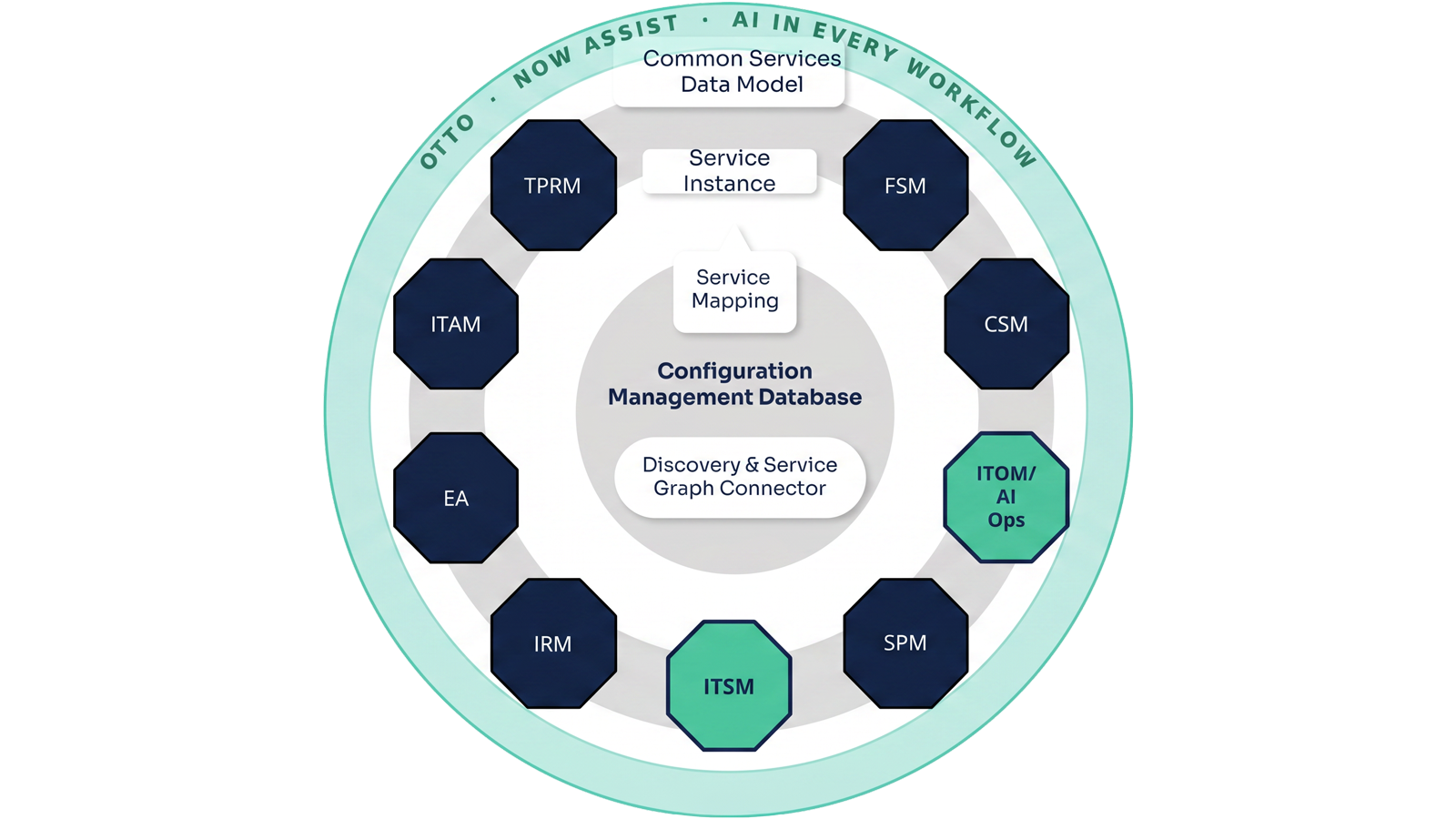
Writing and governing identification rules by hand doesn’t scale, especially in large environments where the volume of incoming CIs is overwhelming, so duplicates linger until the next audit. Only experts could query the CMDB, so most people simply avoided it. Even organizations that got the CMDB clean stalled on service mapping, because stitching infrastructure into an accurate map requires tribal knowledge that lives in people’s heads, a single service can take days to map by hand, and the maps start drifting the moment they’re built.
CSDM fared worst of all, treated as an afterthought. Teams cleaned the CMDB, mapped their crown-jewel services, and never finished connecting the service instance up through the service offering, the business service, and the business capability above it. Each layer of that model answers one question. What broke, what it serves, and who owns it. Build the model late and those links are missing, so the platform can’t answer the questions it was purchased to answer.
Call it the manual tax. The vision was real, but keeping the CMDB clean and the maps current by hand was never sustainable, so the foundation drifted and the promise stalled. For many organizations, the CMDB was never truly optimized. Not because teams didn’t care, but because the complexity outran the tooling.
Why This Time Is Different
ServiceNow’s AI strategy changed the math. Underneath Now Assist and the new agentic capabilities sits the Context Engine, which grounds every AI answer and action in the same CMDB, CSDM, and service mapping data organizations have been accumulating for years. That design choice has a blunt consequence. If the data foundation is weak, the AI is weak, visibly and immediately, in front of the executives who just funded it. Every AI answer inherits the gaps in the model beneath it.
ServiceNow recognized this. The only way its AI gets adopted at scale is if customers can actually finish the CMDB and service mapping work that, for many, has sat incomplete for years. So the recent releases target the manual tax directly, with tooling aimed at exactly the points where the original vision broke down.
Dynamic IRE removes the burden of writing and maintaining identification rules by hand. It generates and tunes its own rules as data arrives, scoring matches in parallel across data sources, and it can run in validation mode alongside existing static rules before anything is committed. The rules that used to drift between admin reviews now improve with every ingestion.
Multi-Source Service Mapping ends the era of picking one mapping method and living with its gaps. Discovered, tag-based, ML-powered, and manual maps combine into one authoritative composite map of each service across on-premises, cloud, and hybrid infrastructure. The map that took days to build by hand, and drifted the day after, now assembles and maintains itself from every signal available.
Now Assist for CMDB removes the expertise gate. Anyone can search and summarize configuration data in plain language, and agentic workflows create clean CIs, walk admins through duplicate remediation, and diagnose Service Graph Connector errors. AI agents can do the same work over MCP, which means the CMDB stops being a system only specialists touch.
These are not convenience features. They exist because ServiceNow needs your foundation finished. That is precisely what makes this moment an opportunity.
The Opportunity Hiding in the AI Push
For years, CMDB remediation lost the budget argument. It was invisible plumbing, and “clean up the CMDB” rarely won against feature delivery. “Get our data ready for AI” is a different conversation. The push into AI has created executive attention, urgency, and funding for foundational data work that never received any of those on its own merits.
It’s the same work under a new mandate, and this time the tooling exists to sustain it. Organizations that use this window finish the foundation once and get everything built on top of it, because the original 2:14 AM vision and the AI roadmap now run on the same data.
Pull it together and the new 2:14 AM looks different. The alert lands at 2:14 already mapped to its service. By 2:20, impact analysis has agentically named the business capability, the blast radius, and exactly who needs to be in the loop. By 2:25, the right team is paged with the dependency chain attached and stakeholder communication is already drafted. By 2:30, the bridge is closed, with six people instead of forty.
Where to Start
Don’t try to fix everything at once. Score the CMDB, service maps, and CSDM against the capabilities that matter most to your most business-critical services, and find what blocks them. Then activate one capability against one of those services, whether that’s Dynamic IRE in validation mode or Now Assist for CMDB, and prove the lift before scaling. Once the pattern is proven, expand it across services, wire the Context Engine into Now Assist and your agents, and start governing the AI components themselves as CIs. The newest discovery patterns map AI agents, models, and prompts into the CMDB, so the same change and impact disciplines that govern your servers can govern your AI.
The Bottom Line
AI doesn’t fix a weak foundation. It just makes the cracks visible, faster. The organizations getting real value out of generative and agentic AI on ServiceNow are the ones treating the AI push as the reason, and the resourcing, to finally finish the CMDB, service mapping, and CSDM work they started years ago. ServiceNow has built the tools to remove the manual tax that stalled that work the first time. The only question left is what your next 2:14 AM will look like.