
Flow by ServiceNow is a standalone AI service desk that runs in Slack, Microsoft Teams, and email, and it doesn’t need a ServiceNow instance to work. ServiceNow launched Flow on October 1, which means organizations running a service desk on ServiceNow, or Moveworks on top of one, now have three ways to put an AI assistant in front of employees. The right answer has already changed more than once this year.
How Flow by ServiceNow Got Here
In less than ten months, the question moved from Moveworks or Virtual Agent to which ServiceNow assistant, and at what commitment level. ServiceNow closed the Moveworks acquisition on December 15, 2025. In February, it launched EmployeeWorks, pairing the Moveworks assistant and enterprise search with ServiceNow workflows, alongside Autonomous Workforce, its first role-based AI specialists. At Knowledge in May, ServiceNow Otto folded Now Assist, Moveworks, and the AI Experience layer into one assistant. The L1 Service Desk AI Specialist, the first of those specialists, has since reached general availability, and in September ServiceNow announced the deprecation of NLU Virtual Agent. Then came Flow.
For anyone who bought Moveworks before December, the contract, the roadmap, and the support desk changed hands without a single decision on their end. That’s the impact. Everything after it is the decision.
Flow by ServiceNow, Otto, and Moveworks Aren’t the Same Layer
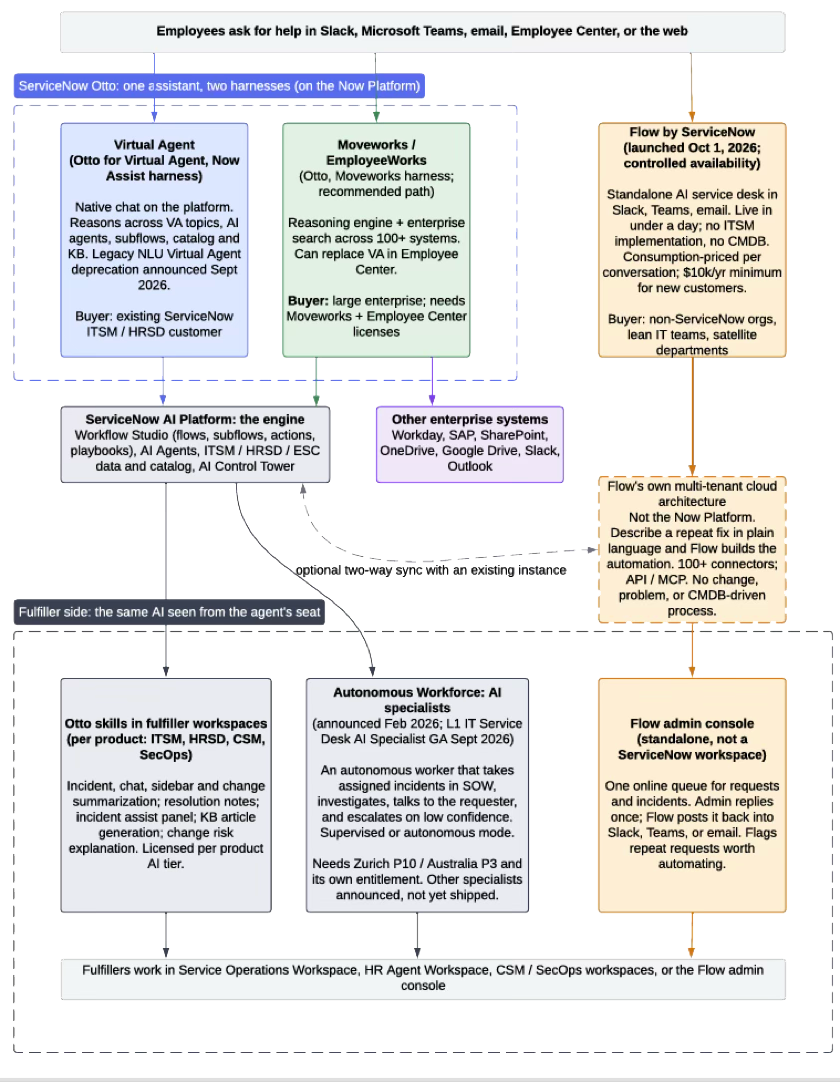
Most of the confusion comes from treating these as three competing chatbots. They aren’t. It’s more useful to think in three layers.
The front door is where the employee asks: Virtual Agent, the Moveworks assistant, or Flow. The engine is what completes the request. On the platform, that’s Workflow Studio, AI agents, the catalog, knowledge, and AI Control Tower for governance. The fulfiller seat is what the analyst sees once a record exists, whether that’s Otto skills in the workspaces, the L1 AI Specialist, or the Flow admin console.
Virtual Agent and the Moveworks assistant are two front doors to the same engine, and both now surface as one assistant, Otto. Inside EmployeeWorks, admins can run Otto on either a Now Assist harness or a Moveworks harness. Flow by ServiceNow is different. It runs its own engine behind its own front door, with an optional two-way sync back to an existing instance. So the real choice is a front door and a commitment level, not a chatbot.
Option A: Keep Moveworks Standalone
Standalone Moveworks still fits when ServiceNow is one of several systems of record rather than the dominant one. If employees get answers from Workday, SAP, SharePoint, and Jira as often as from ServiceNow, cross-system reasoning and search is exactly what the license pays for. ServiceNow says Moveworks will continue to be sold standalone.
There are trade-offs to accept, though. ServiceNow calls the Moveworks harness inside EmployeeWorks the recommended path going forward, and Moveworks support moved to Now Support in March. Renewal is the natural moment to price the standalone contract against the bundled path. If ServiceNow isn’t the main platform,
staying put and revisiting at renewal is reasonable. If it is, the standalone case gets weaker every quarter.
Option B: Move to Out-of-the-Box ServiceNow
For most ServiceNow shops, this is the default, and it comes in two flavors. Otto in Virtual Agent is the native chat on the portal, in Teams, and in Slack. It reasons across topics, catalog, knowledge, and AI agents, and it comes with the Pro Plus and Enterprise Plus AI packages for ITSM, HRSD, and CSM. When ServiceNow is the system of record and requests are predictable, this is the place to start.
EmployeeWorks on the Moveworks harness puts the Moveworks assistant and enterprise search into the employee portal, where it replaces the standard Virtual Agent. ServiceNow calls it the recommended path. It requires a Moveworks license, though Employee Center itself is optional, and the Moveworks harness isn’t yet available in every cloud and region.
Two cautions apply either way. ServiceNow has announced the deprecation of NLU Virtual Agent, so NLU topics need to move to LLM topics regardless, and that work belongs in the budget now. In addition, KeenStack recommends re-testing topic and agent discovery after every upgrade, not just at the first build.
Option C: Adopt Flow by ServiceNow
Flow is the option most likely to be misunderstood. It isn’t a third front door to an existing instance. Instead, it’s a separate service desk on its own architecture, built by ServiceNow. It resolves requests in Slack, Teams, and email with an admin queue behind it, builds automations from repeat fixes described in plain language, connects to more than 100 tools, and syncs both ways with an existing instance when needed.
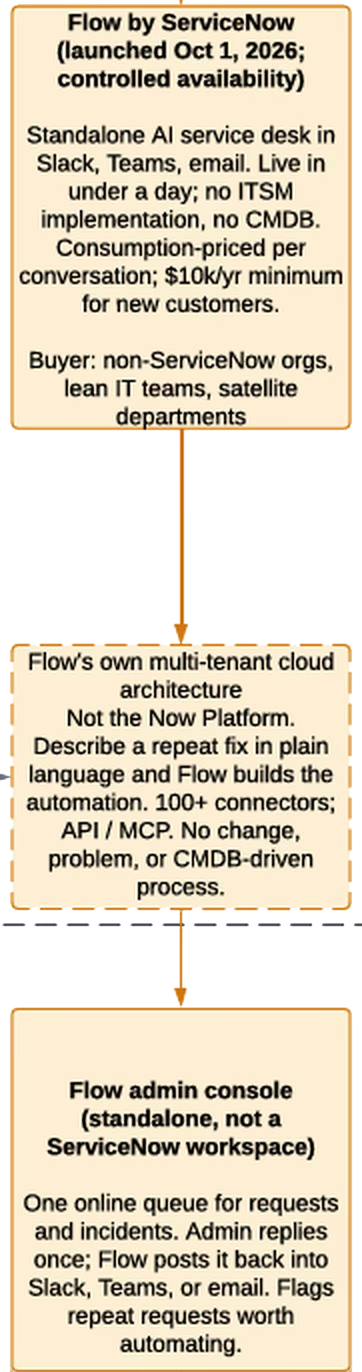
What it doesn’t do matters just as much. ServiceNow says Flow doesn’t replace ITSM: change, problem, and CMDB-driven process stay on the platform, and existing customers can run both side by side. It’s built for companies without ServiceNow that want a desk running in a day, and for satellite teams inside ServiceNow customers that would never sit through a full rollout.
Existing customers run Flow on Assists they already own. New customers pay $2 per conversation and $1 per automation run, with a $10,000 annual minimum. Because Flow launched in controlled availability, North America first, both pricing and features should be treated as early.
Six Questions That Decide It
Six questions usually settle the choice. First, is ServiceNow the system of record for IT and HR, or one of several? One of several points to standalone Moveworks, while system of record points to Option B. Second, where do employees already ask for help? If the answer is Teams or Slack and nobody opens the portal, a portal-first rollout is the wrong place to start.
Third, does the desk need change, problem, or CMDB-driven process in the same tool? If so, Flow is out as the primary desk. Fourth, what AI entitlement is already owned? Otto in Virtual Agent comes with the Pro Plus and Enterprise Plus AI packages, the Moveworks path needs a Moveworks license, the L1 AI Specialist needs an AI Prime SKU, and Flow draws on existing Assists.
Fifth, what release and patch is the instance on? EmployeeWorks needs at least Zurich Patch 9 or Australia Patch 3 (newer store releases raise that floor), and the L1 AI Specialist needs Zurich Patch 12 or Australia Patch 5, so an older instance carries an upgrade cost. Finally, who governs the agents? With AI Control Tower as the control plane, the platform options plug straight in, while standalone Moveworks and Flow need their own answer. A team that can’t answer four of these six has a different first project, and it isn’t a chatbot.
Where Most Organizations Land
Four situations cover nearly every conversation KeenStack has on this topic. Organizations running ServiceNow without Moveworks should start with Otto in Virtual Agent, migrate off NLU topics now, and invest in catalog, knowledge, and flows. EmployeeWorks comes later, when they’re ready to replace the portal. Organizations running ServiceNow with Moveworks should move to EmployeeWorks on the Moveworks harness, keeping the assistant employees already know and consolidating on one front door.
Where ServiceNow is one system among many and Moveworks is already in place, staying standalone through this renewal makes sense. That time is best used deciding whether ServiceNow becomes the main platform. Finally, divisions, subsidiaries, and organizations with no ServiceNow at all are the natural fit for a 60-day Flow by ServiceNow pilot with one team, measured on resolution rate. Inside a larger ServiceNow customer, the sync should be on so the central team can see the records. Otherwise, the risk is a shadow desk drifting away from the desk of record.
In every case, the engine matters more than the front door, because an AI assistant is only as smart as the data underneath it. A great assistant on a thin catalog and stale knowledge fails on day one.
Not sure which front door fits, or whether your catalog, knowledge, and release are ready for any of them? Get in touch with KeenStack and we’ll help you price the paths side by side and map the right one to your environment.